Split Fiction arrives like a lightning bolt to the co-op gaming genre. Developed by Hazelight Studios—the creative minds behind the award-winning It Takes Two—this ambitious title doubles down on everything that made its predecessor great: inventive mechanics, breathtaking environments, and a co-op experience so tightly crafted that it almost feels unfair to play alone. Almost.
This split fiction game review breaks down every major aspect of the game, from its narrative ambitions to its mechanical brilliance, so you know exactly what to expect before you dive in. Whether you’re a seasoned co-op enthusiast, someone who browses review games zone forums for your next big recommendation, or a player who graduated from casual titles like Roblox game review lists and board game reviews into something more immersive—Split Fiction has something to surprise you.
Let’s get into it.
What Is Split Fiction About?
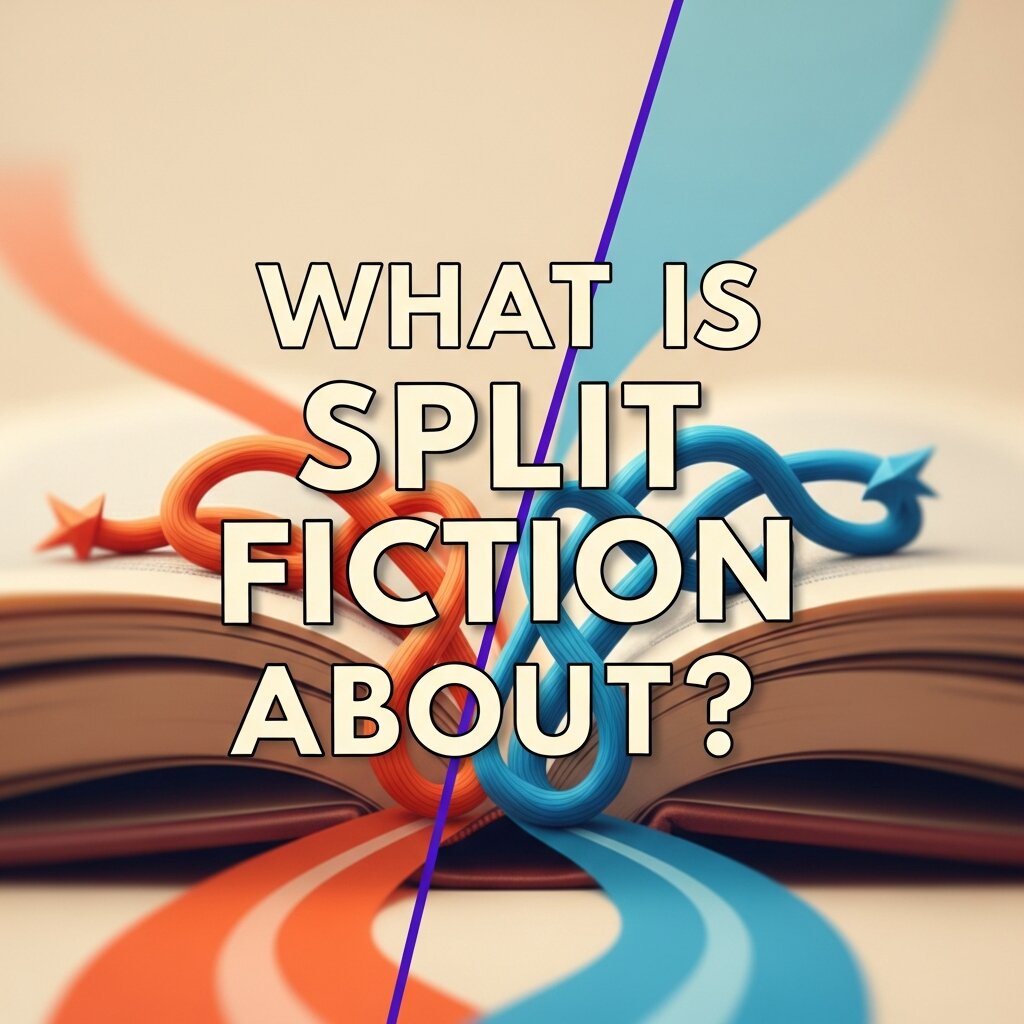 Split Fiction centers on two aspiring writers—Mio, a science fiction author, and Zoe, a fantasy novelist—who find themselves literally trapped inside each other’s stories. A shady publishing corporation called Rader Publishing has been extracting story ideas from writers through a machine that digitizes their imaginations. When Mio and Zoe get pulled into the machine together, they must navigate each other’s fictional worlds to escape.
It’s a premise that’s equal parts clever and convenient. The story gives Hazelight creative permission to jump between wildly different settings—neon-lit cyberpunk cities, ancient dragon-filled forests, surreal dreamscapes—without it ever feeling cheap or arbitrary. Every world shift is narratively justified. That’s a harder trick to pull off than it sounds.
The characters themselves are a study in contrast. Mio is guarded and cynical; Zoe is open-hearted and idealistic. Their friction generates genuine drama, and while the writing occasionally leans on familiar tropes, the voice performances carry it far beyond what the script alone might achieve. By the final act, you’ll care about them both.
How Does Split Fiction Play?
At its core, Split Fiction is a third-person co-op platformer—but that label does very little justice to how the game actually feels. Every chapter introduces new mechanics that are specific to that chapter’s world. One level has you riding giant mechanical dragonflies through a storm. Another puts you in the cockpit of a sci-fi mech battling orbital defense systems. A third turns you into tiny creatures navigating an oversized suburban kitchen.
Each mechanic is introduced, expanded upon, and then discarded before it gets stale. That rhythm—teach, build, escalate, move on—is Hazelight’s greatest design philosophy, and Split Fiction executes it with even more polish than It Takes Two did.
Crucially, the two players always have complementary but asymmetric roles. Mio and Zoe rarely do the same thing at the same time. One might be deflecting energy beams while the other reroutes power conduits. One might be controlling gravity while the other manages momentum. This asymmetry makes communication feel essential rather than optional, which is exactly what the best co-op games do.
The Visual Worlds: A Technical and Artistic Marvel
If there’s one area where Split Fiction makes an undeniable statement, it’s visual design. Each world is rendered with a level of detail and artistic ambition that would be impressive in a single-player, AAA open-world game—let alone a co-op linear experience.
The science fiction chapters lean heavily into retrofuturism: chunky terminals, glowing wire conduits, and sweeping vistas of rings around alien planets. The fantasy sections go equally hard in the other direction, filling screens with bioluminescent forests, crumbling stone temples, and creatures that feel plucked from a mythology textbook.
What elevates this beyond technical showmanship is the thematic coherence of each world. Mio’s science fiction levels carry an undercurrent of cold logic and isolation—sleek surfaces, sharp edges, distant stars. Zoe’s fantasy levels feel warmer, more organic, more chaotic. The visual language reinforces the emotional contrast between the two characters in ways that pure dialogue never could.
Frame rate holds remarkably steady throughout, even during the most particle-heavy setpieces. Load times are short. The technical execution is, by any measure, excellent.
Split Fiction’s Puzzle Design: Challenging Without Being Cruel
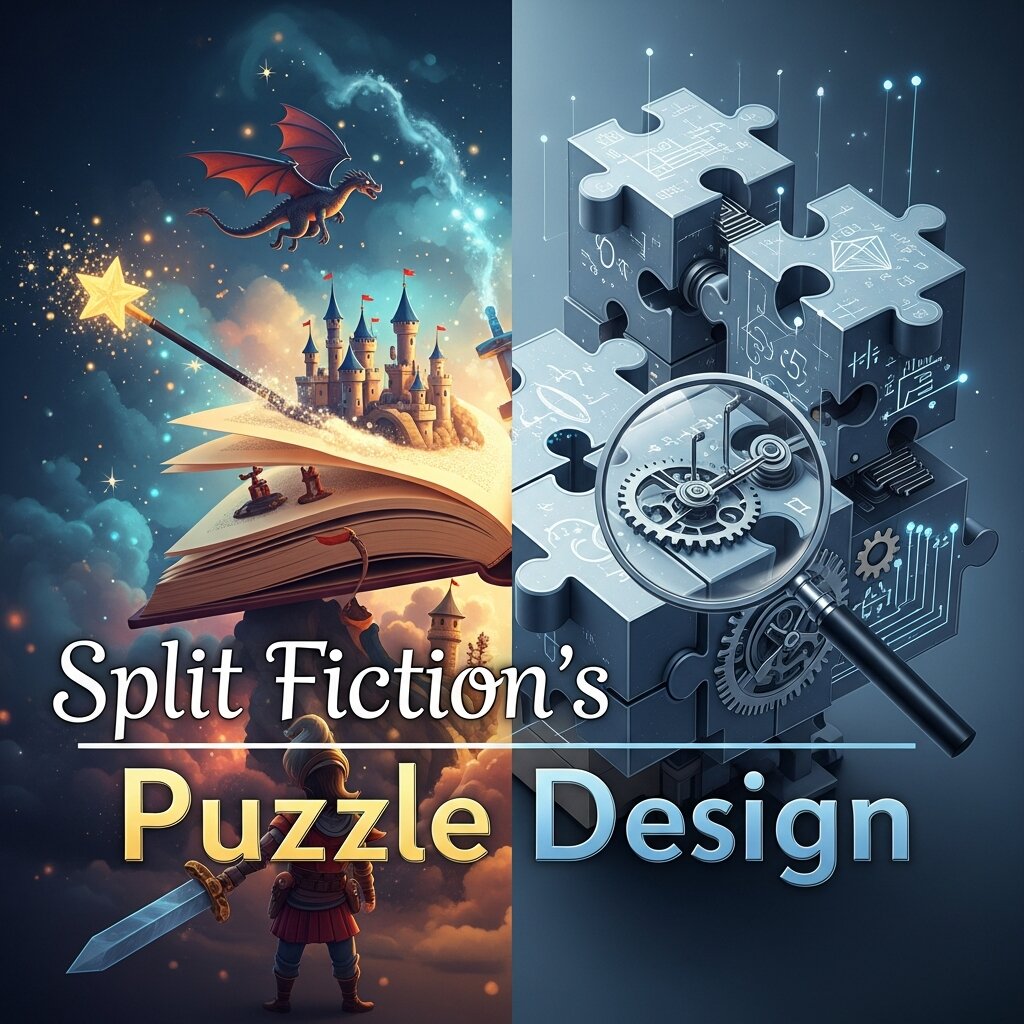
A co-op game lives or dies on its puzzles, and Split Fiction understands this deeply. The puzzles here are designed to require two minds without ever making either player feel useless or bored.
Most puzzles involve spatial reasoning, timing, or the combination of each player’s unique ability in that chapter. The difficulty curve is thoughtfully managed: early puzzles ease you into the mechanics, mid-game puzzles start subverting your expectations, and late-game puzzles demand genuine coordination and lateral thinking.
Importantly, the game never punishes failure harshly. Checkpoints are generous, and respawn times are near-instant. This keeps the flow of play intact even when you hit a wall. You fail, you laugh, you try again immediately. That frictionless retry loop is one of the unsung heroes of the experience.
There are also optional mini-games scattered throughout each world—some competitive, some cooperative—that serve as pressure valves between the main story content. These range from a surprisingly well-designed 2D shoot-em-up to a frantic multiplayer racing section. None of them overstay their welcome.
The Story’s Emotional Payoff
This section requires careful handling, because Split Fiction’s third act hits harder than expected—and doing the story justice without spoiling it is a balancing act.
What can be said is this: Hazelight commits to the emotional stakes it sets up early. The conflict between Mio and Zoe, which initially presents as a personality clash, gradually reveals deeper wounds in both characters. Their respective stories—the sci-fi one and the fantasy one—begin to mirror and comment on their real-world trauma in ways that feel earned rather than forced.
The final few chapters demand more from players emotionally than mechanically. The game slows down, the set pieces become quieter, and the writing steps forward. It doesn’t always stick the landing perfectly, but the ambition is real and the execution is mostly successful.
By the credits, Split Fiction has said something meaningful about creative vulnerability, the fear of failure, and what it means to let someone into your inner world. That’s not something you often say about a co-op platformer.
Replayability and Co-Op Accessibility
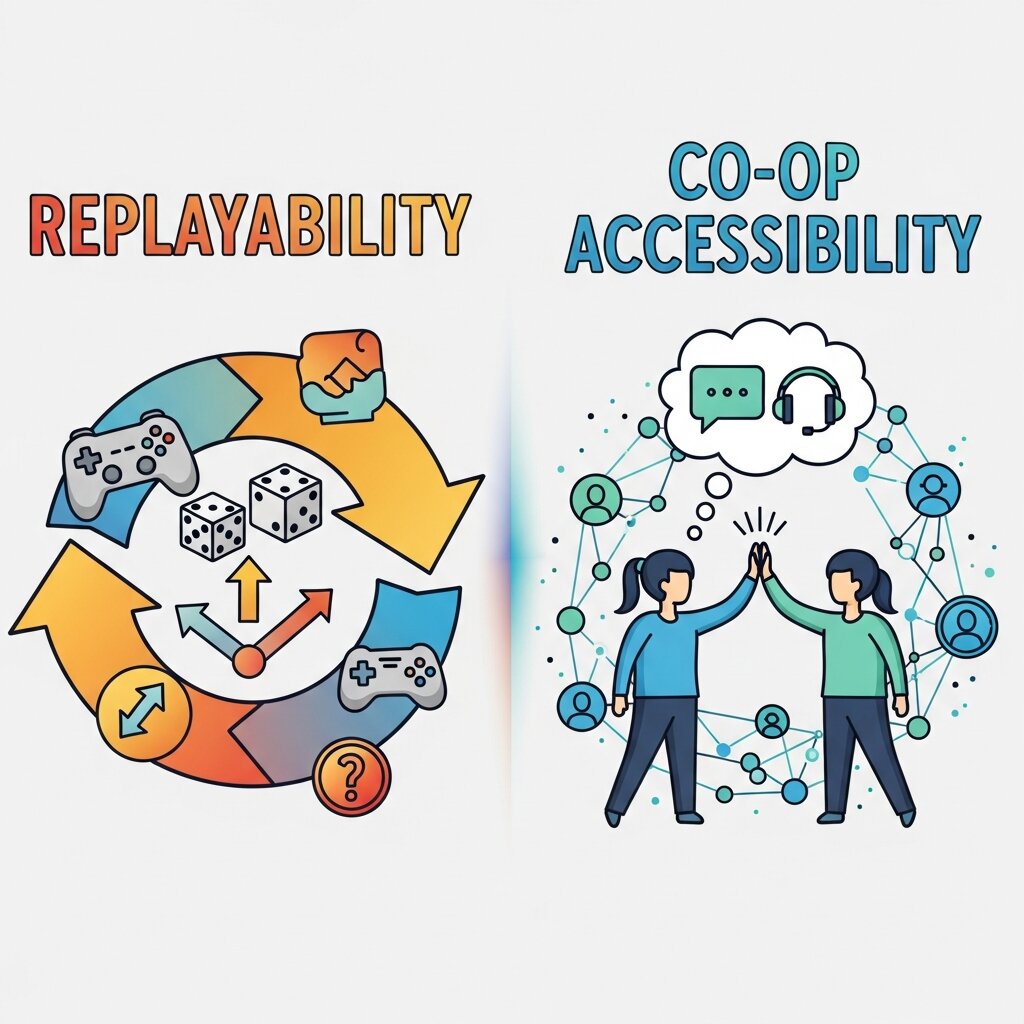 Split Fiction supports a Friend’s Pass system, meaning only one player needs to own the game to play with a friend—the second player downloads a free client and joins. This removes one of the biggest friction points of co-op gaming and is worth highlighting explicitly: it’s a genuinely consumer-friendly policy.
The game runs between 12 and 15 hours on a first playthrough, depending on how thoroughly you explore optional content. That’s a healthy length—long enough to feel substantial, short enough to never drag. For players who’ve worked through review games zone recommendations and want something meatier than typical casual titles, this lands in a satisfying middle ground.
Replayability is modest. The game is designed as a curated experience rather than a sandbox, so returning to it means returning for the moments rather than for new discoveries. That said, many players report replaying chapters with different co-op partners just to experience the communication dynamic shift. That’s a legitimate form of replay value.
How Split Fiction Compares to It Takes Two
The comparison is inevitable. It Takes Two won the 2021 Game of the Year award at The Game Awards and set an extraordinarily high bar for co-op design. Split Fiction doesn’t surpass it—but it doesn’t need to.
Where It Takes Two was grounded in domestic drama and human relationships, Split Fiction is more expansive, more visually ambitious, and more willing to take mechanical risks. The emotional core of It Takes Two remains more powerful simply because its stakes felt more universal. But Split Fiction compensates with sheer variety and a scale that its predecessor never attempted.
Think of them as complementary entries in a growing library of essential co-op experiences rather than direct competitors.
Minor Criticisms Worth Noting
No split fiction game review would be complete without honest critique.
The first two hours move slowly. The game front-loads its exposition and takes time to establish its world and characters before the mechanical variety kicks into high gear. Players who expect immediate fireworks might find the opening chapters underwhelming by comparison to what follows.
Some of the villain-facing dialogue in the third act leans on genre clichés that the rest of the script largely avoids. The corporate antagonist, in particular, is given motivations that feel thin relative to the emotional complexity shown elsewhere.
These are minor complaints against a substantial achievement. They don’t diminish the overall experience—they’re simply the gaps between what the game almost does and what it actually does.
Frequently Asked Questions (FAQs)
1. Is Split Fiction a single-player or multiplayer game?
Split Fiction is designed primarily as a cooperative multiplayer experience. The game requires two players to work together, solve puzzles, and progress through the story. Its mechanics are built around teamwork and communication, making co-op play an essential part of the experience.
2. Do both players need to own Split Fiction?
No. Split Fiction includes a Friend’s Pass feature, allowing one player to purchase the game while a second player joins for free. This makes it easier and more affordable for friends to experience the adventure together.
3. How long does it take to complete Split Fiction?
Most players can finish the main story in approximately 12 to 15 hours. Completion time may vary depending on how much optional content, mini-games, and exploration players engage with throughout the adventure.
4. Is Split Fiction similar to It Takes Two?
Yes, both games are developed by Hazelight Studios and share a strong focus on cooperative gameplay, creative mechanics, and storytelling. However, Split Fiction introduces a broader mix of fantasy and science-fiction settings while offering even greater gameplay variety.
5. What platforms is Split Fiction available on?
Split Fiction is available on major gaming platforms, including PC, PlayStation 5, and Xbox Series X|S. Players should check official platform stores for the latest availability and system requirements.
6. Is Split Fiction suitable for casual gamers?
Absolutely. While some puzzles require coordination and problem-solving, the game features forgiving checkpoints, simple controls, and accessible gameplay systems that make it enjoyable for both experienced and casual players.
7. Are there challenging puzzles in Split Fiction?
Yes. The game features a variety of cooperative puzzles that require teamwork, communication, and creative thinking. However, the difficulty curve is well-balanced, ensuring players feel challenged without becoming frustrated.
8. Does Split Fiction have replay value?
Although the story is linear, players often replay chapters to experience favorite moments, discover missed mini-games, or play with different partners. The variety of mechanics and environments also helps maintain replay appeal.
9. What makes Split Fiction stand out from other co-op games?
Split Fiction distinguishes itself through its constantly evolving gameplay mechanics, imaginative world design, strong character development, and seamless integration of story and cooperative gameplay. Few co-op games offer the same level of creativity and variety.
10. Is Split Fiction worth buying?
For players who enjoy cooperative adventures, puzzle-solving, and story-driven gameplay, Split Fiction is an excellent purchase. Its polished design, emotional narrative, and inventive mechanics make it one of the most memorable co-op experiences available today.
The Verdict on Split Fiction
Split Fiction is one of the finest co-op games released in recent memory. It builds on It Takes Two‘s foundation with greater visual ambition, more mechanical variety, and a narrative that takes genuine creative risks. The puzzle design is smart without being punishing. The worlds are stunning. The characters earn their emotional resolution.
For any two players looking for something that rewards communication, creativity, and genuine collaboration—this is the game. It sits comfortably among the titles you’d place on any serious review games zone recommendation list, well above most Roblox game reviews in terms of depth, and in a completely different category from board game reviews by nature of how fully it uses its medium.